Soprassub

SILVER 3000
Full Cordura 1000 with dump weight pockets of 4 kg (S) or 5 kg (M–XL) each, plus rear weight pockets and a zip pocket on the waist strap.
- Lift11.5 / 14.5 / 19.9 kg
- SizesS · M · L · XL
- CertCE
Home / BCD types
Every buoyancy compensator ever made is one of four architectures. They differ in exactly one thing — where the gas goes when you press the inflate button — and that single difference cascades into trim, drag, cylinder mounting, weighting and how the rig behaves when something goes wrong.
| Jacket vest | Back-inflate soft pack | Backplate & wing | Sidemount | |
|---|---|---|---|---|
| Bladder position | Wraps sides and back | Behind the back only | Behind the back only | Lower back and hips |
| Default trim | Head-high | Flat | Flat | Flat |
| Back structure | Padded soft back | Padded soft back | Rigid metal or composite plate | Soft or light hard pack |
| Cylinder mounting | Cam bands to back panel | Cam bands to back panel | STA or direct to plate | Bungee at valve, clip at hip |
| Twin cylinders | No | No | Yes, with a doubles wing | Yes, two independent |
| Typical lift | 11.5–19.9 kg | 15–20 l | 11–30 l | 12–17 l |
| Modular parts | Bonded assembly | Partly | Fully — plate, wing, harness | Partly |
| Packs for travel | Bulky | Good | Depends on plate material | Very good |
| Shop | Soprassub | Soprassub | Sopras Tek | Sopras Tek |
Architecture 01
The jacket is the BCD most divers learn on, and there is a reason it dominates rental fleets. The bladder wraps around the torso — sides, back, sometimes the chest — so when it is full at the surface it holds you vertical with your chin clear of the water. For a nervous student, a guide managing a group, or anyone waiting twenty minutes for a pickup boat, that is exactly the right behaviour.
Underwater, the same geometry works against you. Gas in the side chambers wants to rise, and it pushes your shoulders up before it lifts your hips. The result is a head-high posture that you have to actively correct with fin position and weight placement. Good jackets narrow the side chambers and add extra exhaust valves so you can vent from more body angles, but they cannot fully escape the physics.
The compensating advantage is integration. Everything is in one bag: harness, bladder, back panel, integrated weight pockets, and usually big side pockets with an octopus slot. Nothing needs assembling, nothing needs matching, and sizing is a single decision.
Full Cordura 1000 with dump weight pockets of 4 kg (S) or 5 kg (M–XL) each, plus rear weight pockets and a zip pocket on the waist strap.

Cordura 1000 with an IWS integrated weight system, 3 kg (XS–S) or 4 kg (M–XL) dump pockets and 2 kg rear trim pockets. Sculptured back panel.

Built for rental rotation: high-visibility shell, very large pockets, octopus slot, and the size printed on the left shoulder so a busy centre can grab the right one.

The straightforward entry jacket: two large side pockets, adjustable cummerbund, octopus slot, and nothing else to go wrong.
Architecture 02
This is the bridge. The bladder moves behind you — so you get the flat trim that makes a wing worth having — but the harness stays a familiar padded vest with a soft back panel instead of a metal plate. Nothing to bolt together, nothing to thread, and it folds flat into a bag.
The trade-off shows up in two places. Without a rigid plate, cylinder load spreads through fabric rather than through steel, so a heavy twin set is out of the question and even a big single can feel less planted. And on the surface, a back-inflate pushes your face toward the water — you learn to lean back slightly, which takes about three dives to become automatic.
For a diver who has outgrown a jacket but is not building a technical rig — an underwater photographer, a travelling instructor, someone who dives twenty warm-water dives a year and wants them to be better — this is often the right answer rather than a compromise.
A horseshoe bladder is open at the bottom, so gas can migrate to one side at low inflation. A donut is a closed ring: gas always finds its way around to the dump valve regardless of your body angle. Donuts are the technical standard; horseshoes are simpler and slightly less bulky.

A 20 litre double bladder — Cordura outside, Nylon 200D inside — on a soft padded harness with no hard plate. Quick-release adjustable shoulder webbing, six stainless D-rings, and weight capacity split between large side pockets (4 kg each) and cylinder-strap pockets (3 kg each).

A step further toward technical: toroidal donut bladder on a padded hard back pack, cummerbund adjustable in three positions, dump valves on both the shoulder and the lower rear, and eight AISI 316 stainless rings. The donut geometry is what makes it work between twin cylinders.
Architecture 03
BP/W is not really a product category — it is a refusal to treat the BCD as one object. A rigid plate handles structure. A separate bladder handles buoyancy. A single length of webbing handles fit. Because they are independent, each one is chosen against a different variable, and each can be replaced, upgraded or repaired without the other two.
That modularity is the practical reason technical divers converge on it. You start with a plate and harness that will outlive several bladders. You buy a 14 litre wing for single-tank diving. Three years later you take a twins course, buy a 20 litre wing, and keep everything else. The system evolves instead of being replaced.
The plate does something else that is easy to miss: it is ballast. A stainless plate at 2.2 kg cancels a meaningful chunk of drysuit lift, so cold-water divers frequently drop their weight belt entirely. Aluminium at around 1 kg does the opposite job — it keeps a travel rig under an airline allowance.

2.5 kg complete, 14 l bladder, one-piece DIR webbing, 400 mm inflator, six stainless D-rings.

Stainless plate, crotch strap, tool and mask pockets, single 30 l or dual 30+30 l PU bladder in Cordura 1500.
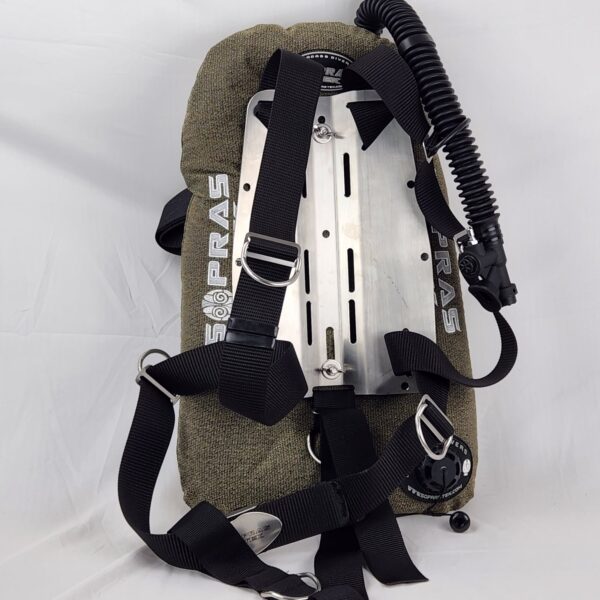
12 l Kevlar bladder on a stainless DIR harness, supplied with single tank adapter and tank belts.

The lightest complete rig here: 11 l bladder, aluminium hard plate, padded shoulders, neoprene crotch layer, 8 stainless D-rings.
Architecture 04
Sidemount came out of cave exploration, where a diver has to fit through gaps that a backmounted twin set will not clear. But the reasons it spread into open-water technical diving have little to do with restrictions.
Both cylinder valves sit in front of you, in reach and in view. You can see your own pressure gauges without contorting. Each cylinder is a completely separate breathing circuit, so redundancy is structural rather than something you arrange with a manifold and an isolator. And when a cylinder is empty you can unclip it and hand it up — which matters more than it sounds when you are climbing a boat ladder.
The bladder geometry is different too. Instead of a wing that inflates behind twin cylinders, a sidemount BCD concentrates lift at the lower back and hips — the natural balance point when the tanks hang at your sides. The inflator routes under the arm and across the chest rather than over the shoulder, so it stays reachable in a prone position.

The current production system. The upper node now bolts directly to the bladder, and the waist bungee runs all the way around the bladder to hold it in against the body — two changes that came out of the previous generation.

A 14 l sidemount-geometry donut on an aluminium or stainless hard plate. Double cylinder straps with stainless buckles, a flexible oval inflator hose, single tank adapter, and a neoprene layer on the crotch strap to stop the webbing abrading your suit.
Worth knowing
There is a small hybrid category — sometimes called sideback — that lets one harness platform switch between sidemount and backmount. You dive the same plate and webbing, and change how the cylinders attach depending on the site.
It is a genuinely useful answer to a specific problem: a diver who trains in a quarry with backmounted twins and travels to caves where sidemount is the only sensible configuration, and does not want two complete rigs. It is not a replacement for either dedicated system, because a compromise geometry never quite matches a purpose-built one. But for the diver who alternates, it removes an entire rig from the gear cupboard.
Next step is the number: how many litres of lift your configuration actually needs.