Configuration
Weighting a backplate and wing from scratch
A repeatable method for finding your ballast and then splitting it between belt, plate and trim pockets — without spending three dives guessing.
Read the article →Buoyancy compensators · independent reference
Everything else about a buoyancy compensator — pockets, D-rings, colours — is detail. The one thing that changes every dive is whether the bladder holds you upright or lets you lie flat. Start there, and the rest of the choice falls into place.

Compact Lite 14L DIR
Start here
Most scuba gear does one thing. A buoyancy compensator does several at once, and every design is a compromise between them.
Get the first two right and you can dive. Get the last two right and the dive becomes effortless.
The fork in the road
Where the bladder sits determines your body angle in the water. Everything downstream — lift sizing, weighting, hose routing, how you exit a boat — follows from this one choice.
The bladder wraps around your sides and back. Stable and upright at the surface, forgiving for new divers, and the standard rental configuration worldwide. Air in the side chambers works against a flat position underwater.
Best for · training, dive centres, warm-water holiday diving, anyone who spends time waiting on the surface.
How a jacket behaves →All the lift moves behind you, but the harness stays a conventional padded vest with a soft back panel. Flat trim without committing to a metal plate, and it packs down for travel.
Best for · advanced recreational divers, underwater photographers, travellers upgrading from a jacket.
Where soft-pack wings fit →Three independent parts: a rigid plate, a webbing harness, a separate bladder. Nothing is glued to anything else, so each piece is chosen, replaced and upgraded on its own. The technical diving standard.
Best for · technical diving, twins, drysuit and cold water, anyone who wants a rig that lasts a decade.
Build a BP/W system →Cylinders ride alongside your body instead of on your back. Both valves stay within reach, gas supply is genuinely redundant, and the profile is low enough for restrictions.
Best for · cave and wreck penetration, shoulder-friendly rigging, divers who want two independent gas circuits.
Sidemount explained →Lift capacity, to scale
Litres of bladder volume is the single specification that decides whether a BCD fits your diving. Roughly one litre of volume gives one kilogram of lift. Here is where the real hardware sits against that scale — light travel wings at the bottom, twin-cylinder systems at the top.
Where to buy
Sopras builds both ends of the range in the Czech Republic. Which shop you land in depends on how you dive, not on how much you want to spend.
Soprassub
Jacket vests built for dive centres and club diving, mid-range vests with integrated weight systems, plus the SPELEO toroidal wing and the soft-pack Horse shoe. Also the place for jacket spare parts, dump valves and inflators.
DIVECENTER · LZ 420 · LZ 1000 · PX 500 · SILVER 3000 · SILVER 4000 · Horse shoe REC · SPELEO 1500
Sopras Tek
Backplates in four materials, wings from 11 to 30 litres, DIR and adjustable harnesses, sidemount systems, and the stainless hardware to build or repair any of it. 188 items across eleven sub-categories.
BASIC TECH · COMFORT TECH · Compact Lite 14L · Granat Tech · LZ Donut SM · Ultra Lite Tek · Sidemount System 2025
Complete systems
A matched package removes the compatibility questions — bolt pattern, wing volume, inflator routing and harness geometry are already settled. These six cover the practical span from a 2.5 kg travel rig to a twin-cylinder deco platform.
A complete rig that weighs 2.5 kg. One continuous piece of webbing runs shoulders and waist, and the cylinder strap slots sit wide enough that the tank stabiliser holds a 12 l cylinder as firmly as a metal STA would.

A stainless plate with crotch strap and pockets for a spare mask and tools. Twelve surgical tubes are strapped around the bladder to pull it in, which cuts drag and speeds up deflation. Available as a single or dual bladder.

Strips down for packing, then goes back together on the boat. Kevlar outer bladder over a lightweight anodised alloy hard pack, with 25 kg of rated lift and a utility pouch in the box.

A toroidal donut bladder on a padded hard back pack. The ring shape fills evenly whether the wing is a quarter full or fully inflated, which is exactly what you want between a set of twins.

Back-inflate lift without a metal plate. The soft padded harness folds into a bag, the 20 l double bladder pairs Cordura outside with Nylon 200D inside, and the crotch strap keeps it planted when you go inverted.

The top of the jacket range. Full Cordura 1000, weight pockets that release by opening a buckle rather than yanking a handle, and an octopus slot cut into the side pocket so the backup regulator has a home.
Parts, not products
A backplate and wing rig is deliberately not a single object. Each part is chosen against a different variable — your suit, your cylinders, your body, your environment — and each can be replaced without touching the others.

Chosen against your exposure suit. Stainless at 2.2–2.4 kg cancels drysuit lift; aluminium at about 1 kg suits warm water and baggage limits; carbon and composite go lower still.

Chosen against your cylinders. Singles wings at 11–16 l wrap one tank without ballooning; doubles wings at 20–22 l span a manifold; dual-bladder versions add a second chamber for overhead diving.
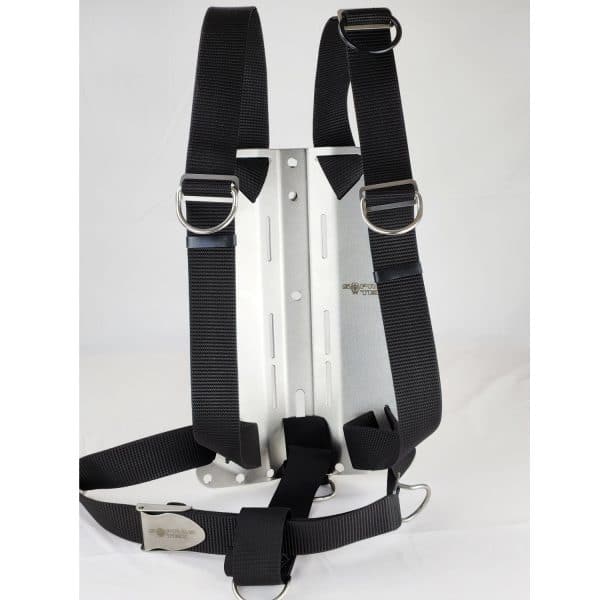
Chosen against your body and how often the rig changes hands. Continuous 50 mm webbing has nothing to fail; adjustable and padded versions trade a few buckles for faster fitting.

D-rings, tri-glides, bolt snaps, cam bands, weight and equipment pockets, inflators and dump valves. 52 hardware items and 35 accessories cover both building a rig and keeping it alive.
Why trim is the whole argument
A diver hanging at 45 degrees presents the whole front of their body to the water. Every fin kick pushes that frontal area forward, so the same distance costs more effort, more breathing gas and more time. On a long dive the difference is measurable in bar.
Angle also breaks other things. A feet-low diver silts a cave floor. A head-low diver cannot see the line. On a decompression stop, an unstable body angle turns depth-keeping into constant work instead of something you do once and forget.
This is why the technical community moved to rear-mounted lift and never moved back. It is also why a photographer or videographer eventually leaves jackets behind, long before they take a technical course.
A wing gets you a flat platform. Where you place lead decides whether you actually lie on it. If you float feet-down with a wing, the fix is usually trim weight higher on the plate — not more air in the bladder.
| Behaviour | Jacket | Wing |
|---|---|---|
| Surface position | Upright, chin clear | Face-forward, needs a small lean back |
| Underwater default | Head-high | Flat |
| Drag when swimming | Higher | Lower |
| Venting feet-up | Awkward | Lower OPV handles it |
| Twin cylinders | Not designed for it | Standard |
| Learning curve | Minimal | A few dives to settle weighting |
Keep it alive
Not use. Not age. Salt crystallising inside the bladder and around valve seats, plus UV on webbing and shell fabric. Both are preventable in under five minutes a dive day.
Common questions
Buoyancy compensator device — also written as buoyancy control device, BC, stab jacket, or simply "wing" when the bladder sits behind the diver. All of these describe the same job: an inflatable harness that carries your cylinder and ballast and lets you adjust buoyancy at depth by adding or venting gas.
Position of the bladder. A jacket wraps it around your torso, which pushes you upright and gives stable surface flotation — useful for students, guides and anyone waiting for a boat. A wing puts every litre behind your back, which holds you flat underwater and cuts drag. Jackets are easier on day one; wings are better on dive one thousand.
Enough to hold your ballast, your plate, the gas swing of your cylinder and the lift you would lose if your suit flooded — plus a margin to support you at the surface. A single-cylinder diver in a 5 mm wetsuit typically needs 11–16 litres. Backmount twins usually need 20–22. Do not round up "just in case": excess volume balloons at partial inflation and spoils streamlining. Run the numbers here.
It will function, but the design works against you. Jackets promote a head-high position, which is the wrong body angle for overhead environments, long decompression stops or multi-cylinder configurations. They also have no clean way to mount twins. Anything past recreational no-decompression diving wants back-inflate lift, and in practice that means a wing.
Technically yes, practically no. A 20 l wing has far more volume than one cylinder needs, so at partial inflation it wraps around your sides — the "taco" effect — which spoils streamlining and makes fine buoyancy adjustments imprecise. If you dive both configurations, own two bladders and keep one plate and harness. That is exactly the flexibility BP/W is designed for.
It depends on what your backup buoyancy is. In open water with a drysuit, the suit is an independent lift source, and most agencies accept a single bladder. In overhead environments, or anywhere suit flooding is a realistic risk, a second chamber removes your dependence on a suit that may already be compromised. For caves and deep wrecks the answer is usually yes.
On a wing, almost always — the inner bladder and the outer Cordura or Kevlar shell are separate parts, and either can be replaced alone. On a jacket vest the bladder is usually bonded or sewn into the shell, so it becomes a service-centre job; a pinhole may be patchable first. Sopras stocks replacement bladders for both, including a direct-fit bladder for the COMFORT TECH and BASIC TECH systems.
Every two to three years, or 200–300 dives, whichever comes first. A full service means stripping the inflator, inspecting valve seats, checking OPV spring tension, pressure-testing the bladder and inspecting webbing and hardware. Between services, test the inflator and both dump valves before every trip, and replace over-pressure valves at service intervals rather than waiting for them to fail.
Journal
Nine longer reads on configuration, materials and service — written for divers who want the reasoning, not the marketing.
Configuration
A repeatable method for finding your ballast and then splitting it between belt, plate and trim pockets — without spending three dives guessing.
Read the article →Materials
What each shell fabric actually resists, where the difference shows up in service life, and when the premium is not worth paying.
Read the article →Travel
Aluminium versus carbon plates, packable wings, and how to get a complete technical set-up under an airline baggage allowance.
Read the article →Read the guides, size your lift, then buy from the catalogue that matches how you dive. Both shops ship from the Czech Republic and both are run by the people who make the gear.