Sopras Tek

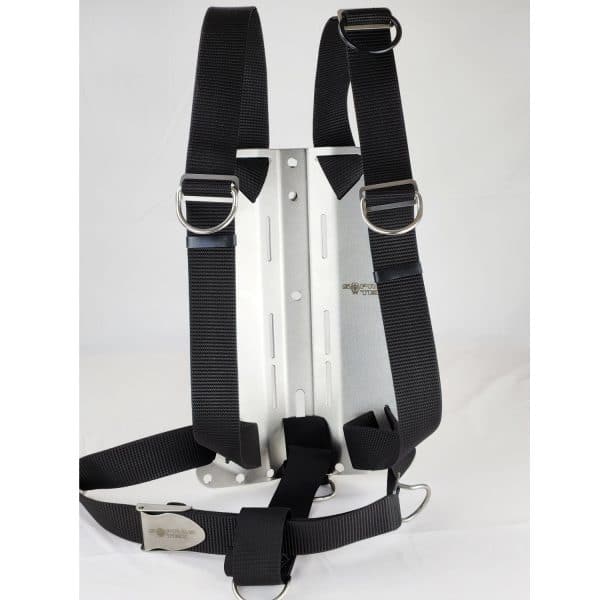
Back plate SS natural
Plain stainless, silver finish, 2.2 kg. The baseline cold-water plate — and the one most people end up back at after trying everything else.
- Weight2.2 kg
- SKU230317
- Range22 plates in category
Home / Backplate & wing
A backplate and wing rig has no model number, because it is not a model — it is four independent parts that happen to be bolted together. Choose each one against the right variable and you end up with a BCD that adapts to your diving for a decade instead of being replaced when your diving changes.
Part 01 · structure
Chosen against your exposure suit. Decides system weight and how much lead you carry.
Part 02 · buoyancy
Chosen against your cylinders. Decides lift capacity and streamlining.
Part 03 · fit
Chosen against your body. Decides whether the rig moves with you or independently of you.
Part 04 · interface
Chosen against your environment. Decides where things clip and how long they survive.
Part 01
A backplate is a flat panel with webbing slots. What makes the choice interesting is that its weight is not overhead — it is lead you were going to carry anyway, relocated to exactly the right place on your back.
A stainless steel plate weighs 2.2 to 2.4 kg. In a drysuit with a thick undersuit, the suit itself is strongly positive, and that negative plate cancels a big share of it. Cold-water divers frequently find the plate removes the need for a weight belt entirely, or cuts it to a token amount. The weight also sits centred and high on the torso, which is a better position for trim than the same lead strung around your waist.
An aluminium plate weighs roughly 0.8 to 1.2 kg. In a 3 mm suit or a rashguard you are already close to neutral, and a steel plate would over-weight you — meaning you would then have to carry more gas in the wing to compensate, which is exactly the ballooning you were trying to avoid. Aluminium is also the pragmatic travel choice: 1.5 kg saved against an airline allowance is real.
Carbon and plastic-carbon composite plates go lower again, around 0.3 to 0.5 kg below aluminium, with rigidity engineered for doubles loads. They are not a compromise on strength; they are a weight decision for divers whose weighting gains nothing from a metal plate.
A plate that reaches past your lumbar curve stops you arching your back — and arching your back is how you fine-tune trim in the water. If you have a short torso, check the plate dimensions before ordering rather than after. Ergonomic plates address this with a contoured or reduced lower section.
A plate is configuration-neutral: the same one runs a single cylinder or a set of twins. What changes is the adapter. For one cylinder you need a single tank adapter — a bracket that gives you cam band slots at the right spacing — or a plate with integrated slots. Sopras stocks both stainless and carbon STAs.
| Material | Weight | Use it when |
|---|---|---|
| Stainless 3 mm | 2.4 kg | Drysuit, thick undersuit, cold water, heavy steel cylinders |
| Stainless 2 mm | 2.2 kg | Drysuit or 7 mm wetsuit, general cold and temperate diving |
| Aluminium | 0.8–1.2 kg | Warm water, thin suits, travel, aluminium cylinders |
| Plastic / carbon | ≈0.6 kg | Minimum system weight, sidemount, travel rigs |
| Carbon fibre | Lowest | Weight-critical configurations where no ballast offset is wanted |
Moving from a steel plate to aluminium in the same conditions means adding roughly 1.5 to 2 kg of lead to keep the same weighting. Do the swap and the weight check in the same session, not on a dive trip.
Plain stainless, silver finish, 2.2 kg. The baseline cold-water plate — and the one most people end up back at after trying everything else.
Part 02
The most common BP/W mistake is buying more lift than the configuration needs. A wing is not a safety margin you can pad — it is a shape that has to wrap the cylinders you actually dive.
Roughly one litre of bladder volume gives one kilogram of lift. That part is simple. The part that catches people is geometry: a singles wing is narrow, so it hugs one cylinder and stays out of the water flow. A doubles wing is wide, because it has to span the gap between two tanks and a manifold.
Put a doubles wing on a single tank and the extra volume has nowhere to go except around your sides. Divers call it the taco, and it does two things: it wrecks streamlining, and it makes small buoyancy adjustments imprecise because the gas sloshes between lobes instead of moving as one mass.
Put a singles wing on twins and you have the opposite problem — not enough lift to support the rig at the surface with full cylinders, which is the moment you least want to be short.
A donut is a closed ring. Gas can travel all the way around it, so wherever the dump valve is relative to your body angle, the gas can reach it. A horseshoe is open at the bottom and slightly less bulky, but at low inflation gas can pool on one side. Some doubles wings add internal baffling — the XTECH geometry constrains lift toward the outer edges, which keeps the profile flatter against your back and sharpens trim.
The shell is a protective cover over the urethane or TPU bladder; it adds no lift. Cordura is the general-purpose woven nylon and resists UV well. Kevlar is para-aramid and resists cuts and punctures far better — the right call for cave and wreck penetration where you are in contact with rock. No-Cut fabric is woven so it does not fray when cut, which matters where a frayed edge would keep growing.
| Configuration | Wing | Notes |
|---|---|---|
| Single AL80 / 11 l alu, warm water | 11–12 l | Minimum bulk, best streamlining |
| Single steel 12 l | 14 l | The default single-tank size |
| Single steel 15 l, drysuit | 14–16 l | Extra margin for surface exits |
| Backmount twins 2 × 10–12 l | 20 l | Donut XL or XTECH |
| Backmount twins 2 × 15 l | 22 l | Or cold water with heavy undersuit |
| Doubles + stages, overhead | 30 l or 30+30 l | Dual bladder for redundancy |
| Sidemount 2 cylinders | 12–17 l | Sidemount-specific geometry |

14 l Cordura donut with a 400 mm inflator and four cylinder slots. Ten stock colours, embroidery available.
DOUBLES RANGE
Ten doubles wings from 20 to 22 litres in Cordura, Kevlar, Kevlar+ and mixed constructions. XTECH adds internal baffling for a flatter back profile.
Part 03
The classic technical harness is one continuous piece of 50 mm webbing threaded through the plate, with a crotch strap. No waist buckle, no chest buckle, no quick release. That is not minimalism for its own sake — it is a design where there is nothing that can open by accident and nothing that can snag a line.
The cost is setup time. A DIR harness is threaded and sized once for a specific body in a specific exposure suit. If you dive a 3 mm suit in summer and a drysuit in winter, you either re-thread it, or accept that it fits one of the two properly.
An adjustable harness adds buckles at the waist or shoulders so the size can change without re-threading. That is the right answer for an instructor whose rig gets loaned out, or for a diver whose suit thickness genuinely swings across the year. Every buckle is one more item on the pre-dive inspection list, and one more thing to rinse — a fair trade if you actually need the adjustment.
Padded and ergonomic variants add material at the shoulder contact points. This is comfort, not structure. It changes nothing about buoyancy, trim or reliability. Divers doing long dives or liveaboard weeks notice it; divers doing forty-minute reef dives generally do not.
Without it, the whole rig rides up your back the moment you go horizontal, and your centre of gravity moves while you are trying to hold a stop. A crotch strap that is too long lets the plate creep; one that is too short pulls the waist belt forward. Set it so the plate does not shift when you change body angle.
The plate should sit flat against your back, shoulder straps parallel to your spine rather than pulling inward toward your neck, and the waist belt on your hip bones rather than your waist. Your inflator should reach your left shoulder with the arm relaxed. Every D-ring should be reachable one-handed, in your actual gloves.
Continuous webbing in standard or hard strap, on an aluminium or stainless plate. A 50 mm soft crotch strap is included; tank belts are ordered separately.
| Type | Choose it if |
|---|---|
| DIR | Dedicated technical use, one diver, consistent suit |
| DIR, hard webbing | You want the webbing to hold its shape when donning |
| DIR + shoulder padding | Long dives, heavy doubles, shoulder pressure |
| ADJ | Shared rig, or suit thickness varies by season |
| Detachable | You strip the harness for travel or service |
| Cool / ergo | Padded back panel, anatomic shoulder shaping |
| Modular | Attachment points need reconfiguring between roles |
| Soft / Ultra light | Travel and sidemount, minimum system weight |
Part 04
The last layer is the one you interact with on every dive: where things clip, where lead sits, and the single most-used mechanical component in the whole system.
Stainless is the standard for anything load-bearing in salt water. Aluminium is lighter but softer and deforms under shock loads — fine for a torch lanyard, not for a stage bottle. Rings should be mounted on rigid loops so the gate faces outward when loaded, and every ring should be reachable one-handed in gloves.
Inspect welds for surface cracking. A cracked weld is replaced, not watched.
52 hardware items →In a correctly configured rig, lead is placed for trim, not just for sinking. Trim pockets at the lower back pull the feet up; hip pockets balance side to side. Integrated pockets on a BP/W harness are typically rated for 2–4 kg each — beyond about 8–10 kg total, put the bulk on a belt and use the pockets for placement.
Find the position in the water, not in the shop. Get neutral, then look at your natural angle without kicking.
15 weight pockets →The inflator is operated on every dive and is the most common source of BCD failure. A free-flowing inflate button on ascent is an uncontrolled ascent in progress. A sticky one leaves you unable to adjust. Both are grounds to pull the rig from service until it is fixed.
Warning signs: extra force needed to press inflate, a brief free-flow when connecting the LP hose, deflate not fully venting in one press, hissing under pressure.
Inflators and valves →Tank belts hold the cylinder to the plate or single tank adapter and come in several lengths for different cylinder diameters. If you run one cylinder on a plate without integrated slots, you need an STA — stainless or carbon — to give the bands the right spacing.
Wet the webbing before the final tighten. Dry-tightened bands loosen as soon as the nylon takes on water.
Tank belts →Slates, wet notes, SMBs, reels and a spare mask need somewhere that is not a D-ring. Mesh or net panels are preferred over waterproof pockets, because a sealed pocket holds water and adds buoyancy unpredictably. Test the closure in your actual gloves before you rely on it.
Equipment pockets →The hose must match your first stage LP port and reach the left shoulder with the arm extended — but no longer, or the excess creates drag and entanglement. Sidemount uses a different, shorter routing across the chest.
Inspect the hose end for micro-cracking, especially on hoses that flex repeatedly at temperature extremes.
BC hoses →Putting it together
The reason to buy a matched complete package instead is simple: it removes every compatibility question in one purchase, and it is a tested configuration. For a first BP/W, or for a dedicated travel rig, that is a good reason.
Questions
Functionally, yes — packages like BASIC TECH, COMFORT TECH and the Compact Lite series use the same plates, bladders and harness patterns as a component build. The difference is that a package assumes a specific pairing. A component build lets you match wing capacity, plate material and harness geometry precisely, but requires you to know what is compatible. For a first BP/W, take the package.
DIR — Doing It Right — is a set of standardised equipment and procedural conventions from the technical diving community, built around streamlining, minimal hardware and configurations that are identical across a team. In BCD terms it means continuous-webbing harness, crotch strap, backplate, rear-mounted wing, and no quick releases. You do not have to adopt the whole philosophy to benefit from the hardware; plenty of divers run a DIR harness without diving in a DIR team.
Usually yes. Standard packages use common mounting geometry, so a Compact Lite plate and harness will accept a larger doubles wing when you move to twins. Confirm that the replacement wing's mounting tabs and inflator connection match your existing plate before ordering — that is the one thing that varies.
Only if your plate has no integrated cam band slots at single-cylinder spacing. An STA bolts to the plate and gives the bands the correct positions, and it also adds a little negative weight. Some systems — the Compact Lite, for instance — use wide strap slots plus a tank stabiliser to hold a single cylinder as securely as an STA would, without the extra part.
Indefinitely, with an annual inspection. Look for sharp edges at the webbing slots that could abrade the harness, elongation or cracking at bolt holes, and any warp from impact. A plate that has taken a serious hit — a cylinder dropped on it — should be checked for concealed cracking before it goes back in the water. There is no routine replacement interval.